
Canada has become one of the most attractive destinations for foreign workers. Known for its strong economy, diverse job market, and immigrant-friendly policies, Canada welcomes hundreds of thousands of workers every year through its Work Permit programs.
In fact, over 600,000 foreign workers enter Canada annually with work permits—proof of its huge demand for international talent. If you dream of a stable job, high salary, and long-term residency opportunities, applying for a Canada Work Permit Visa might be your perfect starting point.
This complete guide will walk you through the entire process—from eligibility and required documents to application steps, fees, timelines, and expert tips.
Why Canada Is a Top Choice for Foreign Workers
Imagine arriving in a country where employers value your skills, the government supports immigrant workers, and opportunities for permanent residency are built into the system. That’s exactly what Canada offers.
Here’s why millions aim to work in Canada:
- High salaries compared to most countries
- Free healthcare for permanent residents
- Safe, peaceful environment
- High demand for skilled and semi-skilled workers
- Pathway to PR (Permanent Residency)
- Strong labor rights and worker protections
From agriculture to IT, construction to healthcare, hospitality to engineering—Canada needs workers across all industries.
Check Also:
- Italy Decreto Flussi: Your Complete Guide to Italy’s Annual Work Entry Quota System
- How to Apply as a Caregiver in Italy
- How to Apply for a Canada Work Permit Visa Application Process.
- Portugal Work Permit Visa Application Process
Types of Canada Work Permit Visas
There are two main categories:
1. Employer-Specific Work Permit (Most Common)
This requires:
- A job offer from a Canadian employer
- Usually an LMIA (Labour Market Impact Assessment)
This permit ties you to:
- One employer
- One location
- One job role
2. Open Work Permit
Does not require a job offer or LMIA.
You may be eligible if you are:
- A spouse of an international student
- A spouse of a skilled worker
- A post-graduate student (PGWP)
- A refugee or vulnerable worker
Understanding LMIA (Labour Market Impact Assessment)
LMIA is one of the most important terms you’ll hear in this process. It is a document that a Canadian employer must obtain to prove:
- No Canadian citizen or PR was available for the job
- They need a foreign worker
- They will pay fair wages
Not all jobs require LMIA, but most employer-specific permits do.
Eligibility Criteria for Canada Work Permit Visa
Before applying, ensure you qualify. You must:
- Have a valid job offer from a Canadian employer (if employer-specific)
- Meet educational and skill requirements
- Have enough funds to support yourself
- Have a clean criminal record
- Be in good health
- Prove you will leave Canada when your permit expires (unless applying for PR)
Documents Required for a Canada Work Permit Application
Below is the complete checklist:
Personal Documents
- Valid passport
- Passport-size photos
- National ID
- Police clearance certificate
- Medical exam (if required)
Job-Related Documents
- Job offer letter
- Employment contract
- LMIA approval letter (if required)
- Proof of qualifications (diploma, certifications)
- Experience letters
Financial Documents
- Bank statements
- Proof of accommodation
- Travel history
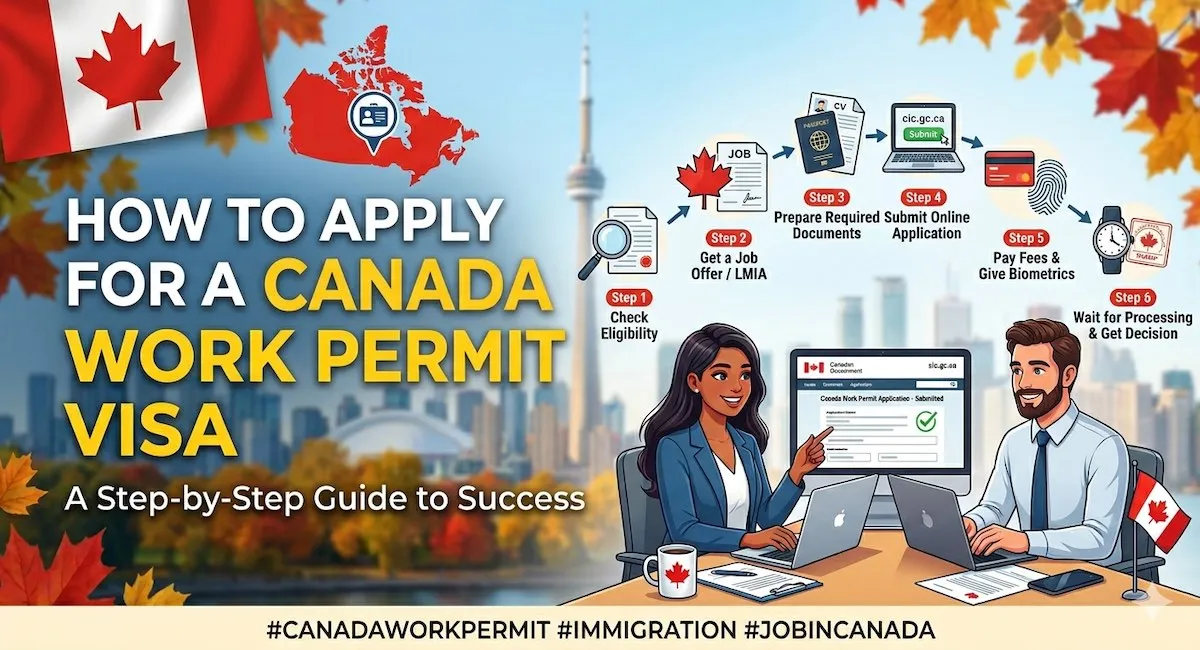
How to Apply for a Canada Work Permit Visa (Step-by-Step)
Step 1: Get a Job Offer From a Canadian Employer
This is the foundation of the process. You can search jobs on platforms like:
- Job Bank
- Indeed Canada
- Company websites
Step 2: Employer Applies for LMIA (If Required)
The employer submits an LMIA application to Employment and Social Development Canada (ESDC).
Step 3: Gather Required Documents
Compile:
- Passport
- Education documents
- Job offer letter
- Proof of experience
- Medical and police certificates
Step 4: Apply Online on the IRCC Portal
Submit your application on the official IRCC website.
Upload:
- Application forms
- Supporting documents
- Biometrics fee receipt
Step 5: Pay the Visa Fees
Fees include:
- Work permit fee
- Biometrics
- LMIA fee (paid by employer if applicable)
Step 6: Give Biometrics
You will receive a Biometrics Instruction Letter (BIL).
Visit your nearest VAC center for fingerprints and photo.
Step 7: Wait for Visa Decision
Processing time depends on your country.
Step 8: Receive Port of Entry (POE) Letter of Introduction
Carry this letter when you travel to Canada.
Step 9: Receive Actual Work Permit at the Airport
The immigration officer issues the work permit when you land in Canada.
Canada Work Permit Processing Time
Processing times vary by country. On average:
- 8–24 weeks for employer-specific permits
- 4–12 weeks for open work permits
Biometrics and background checks may add additional time.
Canada Work Permit Visa Fees
Applicant Fees
- Work Permit: CAD 155
- Open Work Permit Holder Fee: CAD 100
- Biometrics: CAD 85
Employer Fees (If LMIA Required)
- LMIA Fee: CAD 1,000
Success Story: A Worker’s Journey to Canada
Let’s take an example.
Rafiq, a mechanical technician from Bangladesh, dreamed of working abroad.
He applied to multiple Canadian companies online. After two months, he received an interview invitation from a manufacturing company in Ontario. The employer applied for LMIA and got approval.
Rafiq submitted his online work permit application, paid his fees, and completed biometrics.
After 9 weeks, he received his POE Letter.
Today, he earns triple his previous salary and is preparing for his PR application under the Canadian Experience Class (CEC) program.
This could be your story too.
Jobs in High Demand in Canada for Foreign Workers
Canada urgently needs workers in the following fields:
- Healthcare
- Construction
- Truck drivers
- Chefs and cooks
- Warehouse workers
- IT professionals
- Agriculture workers
- Hospitality staff
- Machine operators
- Caregivers
If your skills match any of these areas, your chances are strong.
Benefits of Having a Canada Work Permit
Holding a valid Canadian work permit provides major advantages:
- Legal employment in Canada
- Opportunity to bring spouse and children
- Pathway to Permanent Residency
- Ability to switch employers (in some cases)
- High living standards
- Social benefits after PR
Tips to Increase Your Canada Work Visa Approval
- Apply to genuine employers only
- Prepare a strong resume in Canadian format
- Keep all documents updated and clear
- Be honest in your application
- Show enough financial proof
- Avoid fake job offers or agents
Key Takeaways
- Canada offers many opportunities for foreign workers with high demand across sectors.
- Two main types of work permits exist: Employer-Specific and Open Work Permits.
- LMIA is necessary for many jobs but not all.
- A job offer is the most essential part of the process.
- Processing times vary but average between 8–24 weeks.
- Work permits can lead to Permanent Residency.
Frequently Asked Questions (FAQs)
1. Can I apply for a Canada Work Permit without a job offer?
Yes, but only under specific categories like Open Work Permit, PGWP, or spousal work permits. Most people need a job offer.
2. How much bank balance is required for a Canada Work Visa?
There is no fixed amount, but showing CAD 3,000–10,000 is recommended to prove financial stability.
3. Can my family come with me on a Canada Work Permit?
Yes! Spouses may qualify for an Open Work Permit, and children can get study permits.
4. Is LMIA mandatory for all Canadian jobs?
No. Some jobs and programs are LMIA-exempt, such as intra-company transfers, post-graduate work permits, and certain international agreements.
5. Can a Canada Work Permit lead to Permanent Residency?
Absolutely. Work experience in Canada increases your CRS score and helps you qualify for programs like Express Entry or PNP.
Conclusion
Applying for a Canada Work Permit Visa is one of the most promising pathways for foreign workers seeking better income, stability, and future opportunities. With thousands of job openings and a supportive immigration system, Canada continues to welcome workers from all over the world.
Whether you’re skilled, semi-skilled, or a professional, Canada has a place for you.
Start your journey today—prepare your documents, search for the right employer, and follow the visa steps carefully.
Your Canadian dream may be closer than you think.
